
CRM development for software companies and SaaS founders
CRM development for software companies: multi-tenant and white-label CRM products, or custom extensions to the HubSpot or Zoho CRM you already run.
Muhammad Usman, Digital marketing lead · 7 October 2026 · 6 min read

CRM development for a software company usually means one of two jobs: building a CRM as a product you license to customers (multi-tenant, white-label, with billing), or extending the CRM your own team already runs so it fits your product and sales process. The first is a software product with an architecture; the second is custom development and CRM extensions on HubSpot or Zoho. This guide explains how to tell which you need, what each involves and what we would scope with you.
It is written for software companies and product founders. If you are a services business looking for a custom CRM for your own sales team, our sister site covers that on its custom CRM development page.
Most CRM projects start with a spreadsheet, an inbox and someone's memory. Contacts arrive from Facebook, Instagram, email, WhatsApp, text and phone calls, and the only full record of a deal sits in one person's head. A software company that spots this gap often sees something bigger: the same CRM, built properly, is a product other businesses will pay for. That is a different job from installing a CRM. It needs an account model, billing, an admin back office and a scope the whole build is held against.
When does a configured CRM stop being enough?
When the workflow is the asset. If your sales process, compliance rules or licensing model cannot be expressed by renaming fields in a hosted CRM, you will spend years working around the tool.
A common pattern is a business that outgrew its first tool and now runs three: one for leads, one for client records, one for invoicing. A custom build replaces that with one system whose data model matches how the company sells. For a software company the same logic applies to the product itself. A CRM sold to your customers has to look and behave like yours, not like a rebadged competitor.
What goes into a multi-tenant, white-label CRM?
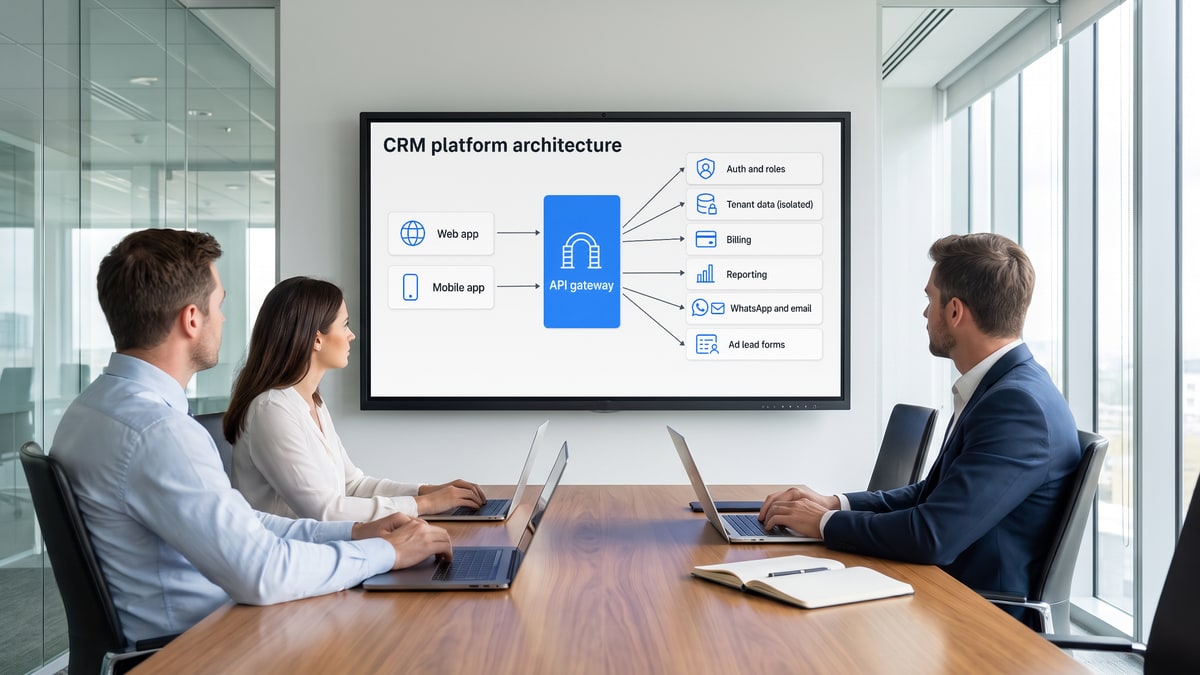
For a software company the decisions that matter are structural: how accounts are separated, who can see what, how customers pay, and how the product behaves once the first hundred accounts exist. A licensable CRM build covers:
- Hard tenant isolation, so one customer's contacts, deals and files are unreachable from another account by any route, including guessed URLs and API calls.
- An admin console to create, configure and suspend accounts without a developer.
- Subscription payments tied to account status, so a lapsed plan restricts the tenant automatically.
- White-label options: the customer's name, domain and branding on a product you operate.
Isolation is the part that cannot be added cheaply later. It has to be in the data model from the first migration.
How should roles and reporting work?
Workflow platforms that combine CRM with applicant tracking or client management live or die on permissions. A three-tier model of admin, manager and employee is the usual starting point: employees work their own records, managers see their team and approve, admins configure everything. Compliance fields, document expiry and audit trails sit alongside.
Reporting sits on top. Pipeline dashboards showing stage conversion, rep activity and forecast are expected now, and predictive views or AI lead qualification can be scoped in. We build these on the data the CRM already holds rather than as a separate analytics project.
Should we build the CRM in-house or with a specialist team?
In-house works when you have a team with spare capacity and the CRM is not the core product. For most software companies neither is true. The engineers who would build it are often the ones shipping your main product, and a CRM can quietly become the project that is always eighty per cent done.
A dedicated team plans for the awkward parts from the start: tenant isolation, role models, payment webhooks, queueing for message integrations and import tools for messy legacy data. Your own engineers stay on the roadmap that makes you money. If you do have an in-house team, we agree the boundary at scoping, for example the CRM module and its integrations on our side.
Can you extend our existing CRM instead of building a new one?
Often that is the better answer. If your team is settled on HubSpot or Zoho and the gap is one workflow the standard objects cannot express, extending the CRM is usually cheaper and quicker than replacing it. Typical custom development and CRM extensions:
- Custom objects or modules for records the CRM does not model by default, such as licences, tenants, renewals or projects.
- Scripted functions and workflow actions for logic the visual workflow builder cannot handle.
- Two-way sync between the CRM and your product through its API, so account status, usage or billing events land on the customer record.
- A small middleware service when the CRM's own automation limits are reached.
The question to settle is where the line sits. An extension keeps the CRM vendor's roadmap and licence costs; a custom build replaces both. When either could work, we set out both options.
Which integrations should a CRM have from day one?
A CRM that does not connect to where leads arrive is a filing cabinet. Integrations we scope into builds:
- WhatsApp and Instagram: lead capture, automated replies and handoff to a human, covered in WhatsApp and Instagram AI qualification.
- Ad platforms and forms: Meta and TikTok lead ads and website forms writing into the CRM, covered in social lead ads capture.
- Routing: rules that assign each lead and escalate when nobody acts, described under CRM routing and handoff.
- Voice: AI calling that pre-qualifies new leads, under VAPI voice qualification.
For the back-office side (accounting, billing and support tools), read our guide to system integration for CRM, accounting and back-office tools.
Have you done CRM work like this before?
Our closest proof is integration and automation work. For Easy Wedding, the flagship site in a multi-country wedding-planning network, we implemented Zoho CRM alongside SEO, web development, campaign management and a WhatsApp API chatbot. For T72, a UAE events company, we built WhatsApp API automation and a chatbot, plus the launch microsite for an event with WhatsApp as the main enquiry channel. Those are integration and automation projects, not licensed multi-tenant products, and we describe them as what they are. GoDesign as a whole has delivered 900+ projects in 50+ countries since 2018.
"Great and reliable collaboration — the work was completed professionally, cleanly, and exactly as agreed. I'm very satisfied with the result and can absolutely recommend working with him."
Jens, Germany, via Freelancer, on a search platform data collection tool

What does CRM development cost, and how is it scoped?
A licensable multi-tenant CRM is a custom scope, quoted after we agree the data model, roles, screens, integrations and what is out of scope. A fixed number for an unscoped CRM would be a guess, so you see the scope and the quote before any code is written.
If what you need is a CRM set up for your own sales team, with lead capture, qualification and routing, our Full Journey package starts from USD 4,500 and covers CRM implementation and routing for up to ten users, or a custom quote for larger implementations. Smaller jobs, such as wiring lead sources into the CRM you already run, start at USD 950.
Where this fits
This connects to our professional services industry page, the closest fit for software teams, and to the full list of solutions we build. For AI features inside your own product, see ChatGPT integration for web apps and software teams.
"Working with Kaiser was a great experience. He was responsive, detail-oriented, and truly understood the vision. The final result is clean and modern. I would highly recommend them."
Majdeline, United States, via Freelancer, on a trade show landing page
Have a CRM product or platform in mind? Send us the brief. Tell us who the users are and how accounts should work, and we will reply within one business day with next steps.